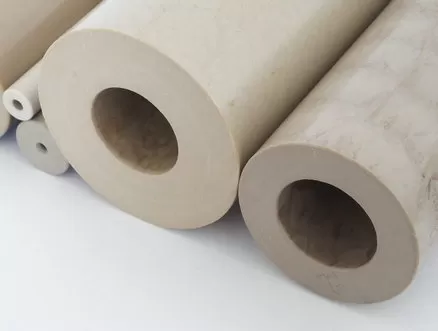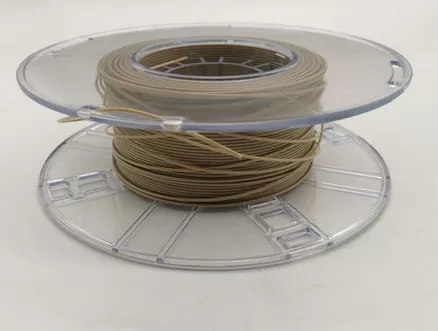

Have you ever encountered this situation?
Two components made from the same Polyether Ether Ketone (PEEK) material perform completely differently.
One can bend repeatedly without failure, while the other cracks unexpectedly under similar conditions.
In industries such as aerospace, medical implants, and high-end manufacturing, PEEK is widely valued for its high temperature resistance and excellent chemical stability. However, many engineers overlook a critical property that often determines whether a part survives real-world stresses:
Elongation at Break.
This parameter is often hidden at the edge of a technical datasheet, yet it can be the deciding factor in whether a PEEK component performs reliably in complex structural applications.
In this article, we explore the science behind PEEK toughness and explain why elongation at break deserves much more attention.
The elongation at break of PEEK represents the material's ability to deform plastically before fracture.
Simply put:
Higher elongation at break = greater toughness
Lower elongation at break = higher risk of brittle failure
For components with:
uneven wall thickness
complex supports
stress concentration zones
dynamic loading
this property becomes extremely important.
Instead of cracking suddenly, a material with high elongation at break can absorb energy and redistribute stress through localized deformation, preventing catastrophic failure.
In many real applications, elongation at break can be more important than pure tensile strength when dealing with complex structures.
With nearly two decades of material development experience, we have observed that toughness often determines the success or failure of many PEEK applications.
Elongation at break is influenced by several key factors, including:
Molecular weight
Molecular weight distribution
Crystallization behavior
Material purity
Processing conditions
By carefully controlling polymer structure and processing parameters, it is possible to design PEEK materials that maintain:
high strength
high temperature resistance
excellent toughness
strong energy absorption capability
| Core Advantage | Description |
| Excellent Impact Resistance | Absorbs energy during sudden loads or impacts, reducing the risk of brittle fracture. |
| Superior Fatigue Resistance | Performs well under repeated stress cycles, delaying crack initiation and extending service life. |
| Improved Processability | High ductility reduces risks of film tearing, fiber breakage, or layer separation during manufacturing processes such as film stretching, fiber spinning, and 3D printing. |
Optimizing elongation at break can generate direct commercial value for various industries.
| Customer Type | Application Benefits |
| Film Manufacturers | More stable stretching processes, lower film breakage rates, improved yield and production efficiency. |
| Injection Molded Parts Manufacturers | Increased resistance to brittle fracture during installation and service life, improving product reliability. |
| 3D Printing Service Providers | Stable filament feeding, stronger layer bonding, and tougher printed components. |
PEEK is a semi-crystalline polymer, meaning its mechanical properties are determined by the balance between:
Rigid crystalline regions
Flexible amorphous regions
The degree of crystallinity acts as a key lever for adjusting mechanical performance.
Typically achieved through slow cooling or annealing.
Characteristics:
higher stiffness
improved creep resistance
lower elongation at break
Best suited for:
bearings
structural housings
dimensionally stable mechanical components
Usually achieved through rapid cooling.
Characteristics:
higher flexibility
increased molecular mobility
significantly higher elongation at break
This structure is ideal for applications requiring high toughness and flexibility.
A customer producing 0.05 mm PEEK films adopted a low-crystallinity high-toughness PEEK resin.
Results:
dramatically reduced film breakage during biaxial stretching
improved production stability
higher manufacturing yield
A medical device manufacturer used a high-elongation PEEK filament for printing surgical guides.
Results:
extremely high printing success rate
strong layer adhesion
printed parts passed simulated surgical impact tests without cracking
Instead of focusing only on strength and temperature resistance, engineers should prioritize toughness requirements based on the specific application.
(insulation films, copper-clad laminates, acoustic diaphragms)
Key requirement:
High elongation at break
Benefits:
stable film stretching
improved bending fatigue resistance
better production consistency
Material factors to consider:
molecular weight distribution
resin purity
(filter meshes, braided sleeves, medical fibers)
Key requirement:
combination of high strength and high elongation
Material factors:
stable melt spinning performance
high molecular weight resin
narrow molecular weight distribution
Key requirement:
A delicate balance between:
yield strength
elongation at break
Why?
sufficient stiffness is needed to provide locking force
sufficient toughness is required to prevent brittle failure during tightening and long-term service
Elongation must meet two conditions:
The filament itself must have moderate flexibility
(typically >30% elongation) for smooth feeding.
Printed parts must have strong interlayer bonding and overall toughness.
The world of PEEK materials goes far beyond just high strength and high temperature resistance.
Elongation at break is the hidden parameter that unlocks PEEK's full potential in:
flexible components
dynamic loading environments
high reliability applications
It is not a fixed number.
Instead, through scientific control of crystallinity, material scientists can tailor elongation performance to match specific engineering requirements.
If your product needs to:
bend without cracking
stretch without tearing
absorb impact without fracturing
then choosing a PEEK supplier that truly understands toughness engineering is far more important than simply selecting a "high strength" material.
Because true reliability comes from precise control of material performance.
And it all begins with understanding elongation at break.
Copyright © PEEKCHINA | Taizhou Ark International Trade Co.,Ltd. All Rights Reserved |
Sitemap
| Powered by



 EN
EN