In today's high-performance engineering industries, standard plastics are often unable to meet the demands of extreme temperature, wear resistance, and dimensional stability. This is why PEEK has become one of the most important advanced engineering thermoplastics in aerospace, medical, semiconductor, automotive, and industrial applications.
But for even more demanding environments, manufacturers frequently use reinforced PEEK materials instead of pure PEEK resin. Among the most widely used options are carbon PEEK composite and glass PEEK composite materials.
Understanding the differences between these materials is essential when selecting the right solution for precision components, structural parts, bearings, seals, or electrical systems.
To understand composite grades, it is important to first understand PEEK material composition itself.
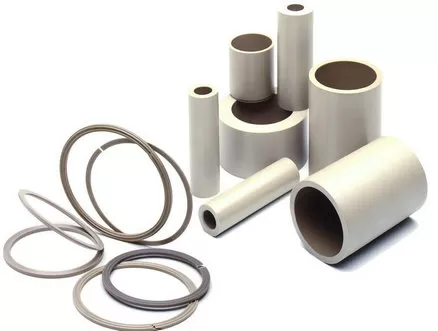
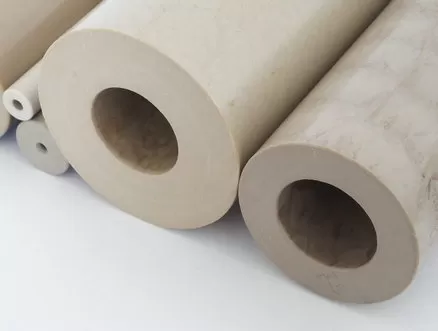
PEEK, or Polyetheretherketone, is a semi-crystalline high-performance polymer made from aromatic molecular chains combined with ether and ketone functional groups. This unique molecular structure gives PEEK exceptional thermal stability, mechanical strength, and chemical resistance compared with conventional engineering plastics.
Pure PEEK already offers impressive performance characteristics, including:
Continuous operating temperatures up to 260°C
Excellent resistance to chemicals and hydrolysis
High mechanical strength and rigidity
Very low moisture absorption
Outstanding fatigue resistance
However, many industrial applications require even higher stiffness, lower thermal expansion, or improved wear resistance. This is where reinforced PEEK composites become important.
A PEEK composite is created by adding reinforcing materials into the base PEEK polymer. These reinforcements improve specific performance characteristics depending on the application requirements.
The most common reinforcement materials include carbon fiber and glass fiber. By modifying the internal structure of the polymer, manufacturers can significantly improve overall PEEK composite material properties.
Compared with virgin PEEK, reinforced composites can provide:
Higher dimensional stability
Better wear resistance
Increased stiffness
Improved compressive strength
Lower thermal expansion
Because of these advantages, PEEK composites are now widely replacing metal components in lightweight engineering systems.
Among all reinforced grades, carbon PEEK composite is considered one of the highest-performance options available.
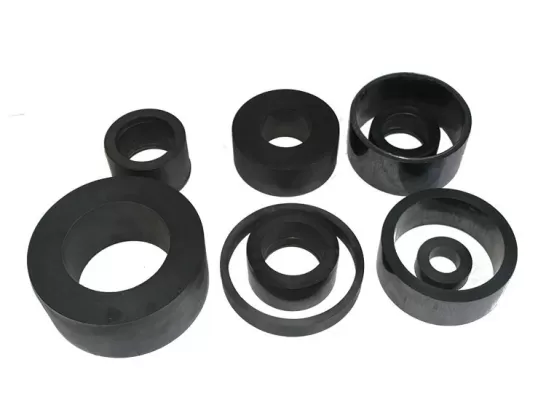
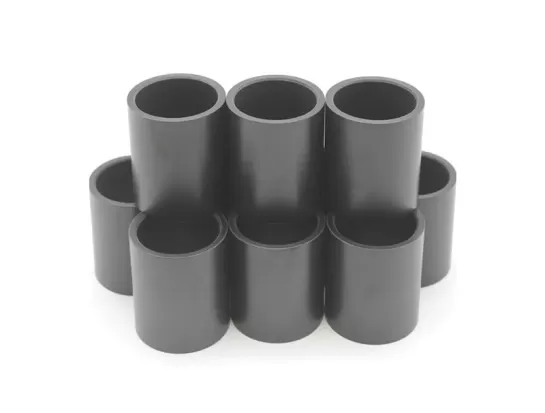
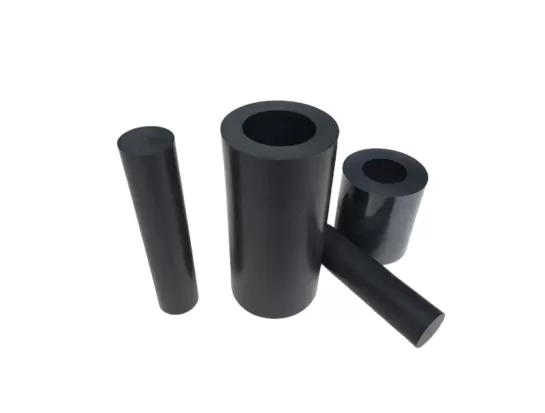
Carbon-filled PEEK typically contains 10% to 30% carbon fiber reinforcement. The addition of carbon fibers dramatically increases stiffness while also improving wear resistance and thermal conductivity.
In real-world applications, carbon PEEK composites are often selected for situations where traditional plastics fail under heavy mechanical loads or high-speed friction conditions.
One of the biggest advantages of carbon-filled PEEK is its excellent dimensional stability. The material expands less under heat compared with standard PEEK, making it ideal for precision engineering environments.
This material is commonly used in:
Aerospace structural components
Semiconductor manufacturing equipment
Compressor and pump parts
High-speed bearings
Robotics and automation systems
Another important benefit is weight reduction. Carbon PEEK composites can replace metal parts while significantly reducing overall system weight, which is especially valuable in aerospace and high-end industrial equipment.
While carbon-filled grades focus on maximum performance, glass PEEK composite materials are often chosen as a more economical reinforcement solution.
Glass-filled PEEK is typically reinforced with 10% to 30% glass fiber. Compared with pure PEEK, the material becomes stiffer and more dimensionally stable while still maintaining excellent electrical insulation properties.
For many industrial applications, glass-filled PEEK offers the ideal balance between mechanical performance and cost.
Unlike carbon-filled grades, glass-filled PEEK remains electrically insulating, which is important for electrical and electronic components.
Industries commonly use glass PEEK composites for:
Valve seats and pump components
Electrical insulation systems
Structural supports
Industrial machinery parts
Analytical instrument components
Because of its balanced performance profile, glass-filled PEEK is often preferred in large-scale industrial manufacturing where cost control is also important.
Although both materials improve the performance of pure PEEK, they are designed for different engineering priorities.
Carbon PEEK composites provide superior stiffness, wear resistance, and thermal stability. They are ideal for demanding applications involving friction, high loads, or precision tolerances.
Glass PEEK composites, on the other hand, provide strong mechanical reinforcement at a lower cost while maintaining electrical insulation capabilities.
In simple terms:
Carbon-filled PEEK focuses on maximum engineering performance
Glass-filled PEEK focuses on balanced strength and cost efficiency
The correct choice depends entirely on the application environment and performance requirements.
| Property | Pure PEEK | Carbon PEEK Composite | Glass PEEK Composite |
| Strength | High | Very High | High |
| Stiffness | Medium | Very High | High |
| Wear Resistance | Good | Excellent | Moderate |
| Thermal Expansion | Moderate | Very Low | Low |
| Cost | Medium | High | Medium |
| Electrical Properties | Insulating | Conductive (slightly) | Insulating |
Modern industries are increasingly replacing metals with advanced thermoplastic composites. PEEK materials are at the center of this transition because they combine lightweight properties with exceptional durability.
Compared with metal components, PEEK composites can offer:
Lower overall system weight
Corrosion resistance
Reduced maintenance requirements
Longer service life
Better chemical resistance
This is especially important in industries where reliability, precision, and weight reduction directly affect system performance.
As manufacturing technologies continue to improve, demand for high-performance PEEK composite materials is expected to grow rapidly across aerospace, medical, semiconductor, and industrial sectors.
Understanding PEEK composite material properties is essential for engineers and manufacturers selecting materials for high-performance applications.
The base PEEK material composition already provides excellent thermal and chemical resistance, but reinforced grades deliver even greater performance.
For applications requiring maximum stiffness, wear resistance, and dimensional stability, carbon PEEK composite materials are often the best choice. For projects requiring balanced mechanical properties and cost efficiency, glass PEEK composite materials remain an excellent solution.
As industries continue moving toward lightweight, high-strength engineering materials, reinforced PEEK composites are becoming one of the most important alternatives to traditional metals.
Copyright © PEEKCHINA | Taizhou Ark International Trade Co.,Ltd. All Rights Reserved |
Sitemap
| Powered by



 EN
EN